
ARE QUESTIONS DANGEROUS?
What Happened When Dominick Bonny Was Questioned?
This week I stumbled across something interesting, and it made me wonder just how widespread it really is.
Over the course of a few days, I left comments on several local articles. They weren't insults. They weren't profanity. They weren't personal attacks.
Most weren't even arguments.
They were simply questions.
Sometimes I asked for evidence. Sometimes I questioned a conclusion. Sometimes I pointed out information that seemed to contradict the article's narrative.
In several cases, my comments disappeared. Maybe it was just a glitch, but it happened to multiple people multiple times, only affecting certain people.
One example was a recent post by Dominick Bonny.
He posted a photo of a “Leaving MAGA” billboard and wrote:
“There’s a new billboard up in Wenatchee and the folks behind it aren’t even hiding their identities! I’m going to be interviewing those folks soon and will have an article about it out soon.”
He later added:
“We also talked about why he's not hiding his identity – like some folks in our community who put up a billboard with a message of divisiveness and bigotry just across the parking lot but won’t stand by it publicly.”
His comments about us “not even hiding” our identities could certainly be read as a jab at our use of pen names, which we openly explain on our website. We don't believe the individual writer needs to become the focus of the message.
But then something more interesting happened.
Bonny made a comment about us in the thread. I responded—not with an insult, profanity, or personal attack, but by challenging what he had said.
My response disappeared. More than once, and on more than one post.
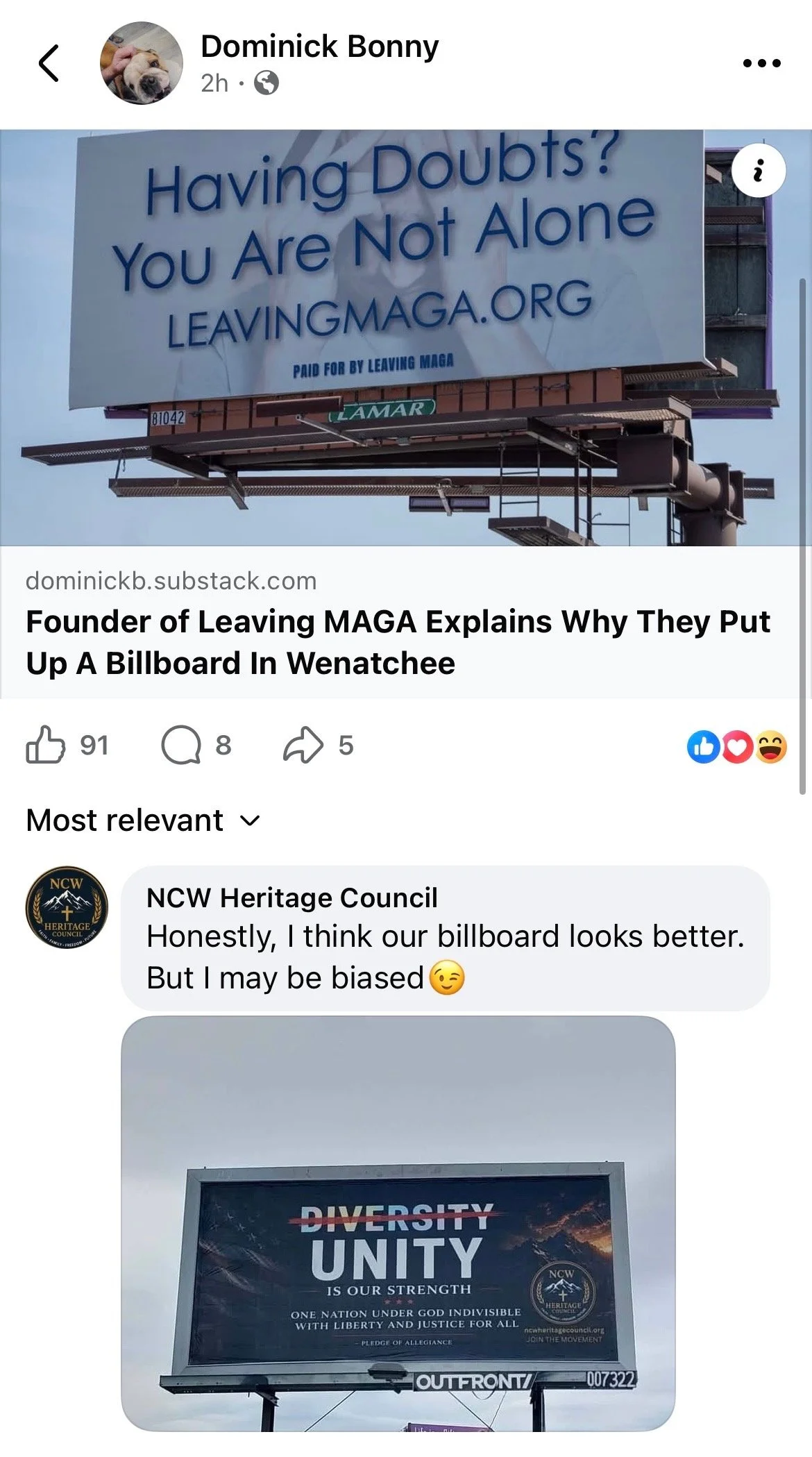
I recently left another simple comment on one of his newer posts. I took a screenshot of it after posting. The comment was subsequently vanished.
If it was removed, that raises a very simple question:
If we're willing to let someone publicly criticize us, why shouldn't we be allowed to respectfully answer?
If the conversation is open enough for the criticism, shouldn't it also be open enough for the response?
That Got Me Thinking
If your position is true, why fear questions or comments?
Why delete disagreement instead of answering it?
There is a strange contradiction in modern public discourse. We constantly hear calls for conversation, dialogue, and listening to different perspectives. Yet the moment someone politely asks an inconvenient question, the conversation sometimes ends—not with an answer, but with a delete button.
Perhaps the goal was never conversation.
Perhaps the goal was consensus.
And those are two very different things.
That raises another question:
Why are respectful questions so threatening?
Perhaps it is because many of us have come to attach our identity to our opinions. When our ideas are challenged, it can feel as though we are being challenged. Instead of evaluating the argument, we instinctively defend ourselves.
Christians should think differently.
We Should Think Differently
Our identity is not found in our opinions or in what we write. As Christians, even our personal opinions should be submitted to Scripture. Our thoughts, convictions, and arguments are not our ultimate authority—God's Word is.
So when someone challenges an opinion of ours, we should not take it as an attack on our identity. And when someone challenges what Scripture actually teaches, we should not respond with fear or defensiveness. We should open the Scriptures and examine the claim.
There is an important distinction: an attack on our opinion is not necessarily an attack on God. But when God has clearly spoken, rejecting His Word is ultimately a rejection of His authority—not merely a disagreement with ours.
That is precisely why Christians should be willing to open the Bible and examine the claim. We don't need to defend God by protecting our own arguments.
If God's Word is true, it has nothing to fear from honest questions.
And if we discover that we were wrong, then we haven't lost anything.
We've gained something far more valuable than being right:
the truth.
If I ask a respectful question and you answer it with evidence, we both benefit.
If my question exposes a weakness in my own thinking, I benefit.
If it exposes a weakness in yours, you benefit.
But if questions are simply deleted, then no one learns anything.
We don't grow by silencing disagreement.
We grow by testing our beliefs against reality.
The Standard We Try to Follow
That is a standard we should all aspire to.
At NCW Heritage Council, we try to hold ourselves to that same standard.
Respectful disagreement is welcome.
We remove comments only if they are vulgar, threatening, spam, or contain links that could expose readers to harmful or malicious content. We do not delete comments simply because someone challenges our views.
If we're wrong, we want to know it.
If we're right, honest questions only make the truth clearer.
Questions and comments are not the enemy of truth.
They are often how we find it.
Perhaps that is a standard worth applying more broadly.
It would be interesting to see how many self-described “neutral” journalists, organizations, and public commentators would be willing to adopt the same standard.
If open dialogue is truly a virtue, respectful questions should not be something to fear.
They should be something to welcome.
Sources & Documentation
This article is based primarily on publicly available posts and the author's own documented interactions.
Primary sources
Dominic Bonny's public Facebook posts and comments referenced in this article.
Screenshots retained by NCW Heritage Council showing the author's comments before they were removed.
NCW Heritage Council's explanation of its use of pen names and editorial approach:
NCW Heritage Council — Meet the Team
Legal and constitutional references
All quotations attributed to Dominic Bonny should be checked against the screenshots or original public posts retained by NCW Heritage Council. Where this article expresses an interpretation rather than a directly verifiable fact, it is presented as such.
